TRUMPARTNER CUSTOM EVA CASE MANUFACTURER OEM & ODM · FACTORY DIRECT

Complete Guide to the Thermoforming Process


Protective cases for critical equipment must deliver more than just storage—they must ensure readiness under pressure forming. When failure isn’t an option, the insert’s fit, strength, and reliability play a vital role in performance.
Thermoforming offers a dependable solution. Using heated plastic sheet options creates durable, custom-fit interiors that protect sensitive tools and devices in demanding environments.
This guide straightforwardly explains the thermoforming process. You’ll learn what it is, why it’s used, and how it supports key industries like military, medical, and electronics.
Whether you’re considering it for performance, volume, or material flexibility, this overview will help you understand its strengths and practical benefits, including compatibility with material handling equipment.
What Is Thermoforming?
Thermoforming is a versatile plastic manufacturing process that involves four fundamental stages: heating, forming, cooling, and trimming. At its core, the process begins by heating a thermoplastic sheet until it becomes soft and pliable.
This sheet is then shaped over or into a mold using various forming methods such as vacuum, pressure, or mechanical forming. Once the plastic cools and solidifies to hold the mold’s shape, any excess plastic is trimmed to create the final product.
This process is highly adaptable and accommodates a range of thermoplastic sheet thicknesses, from thin-gauge films used in disposable packaging to heavy-gauge sheets for manufacturing robust, durable items like custom hard cases.
Thermoforming molds can be metal molds, machined, hand-crafted, or even 3D printed, depending on the volume and complexity requirements.

Why Thermoforming Matters for Rugged Case Interiors
A rugged protective case with a precision thermoformed insert secures sensitive electronic equipment.
Protective cases are the first defense against operational threats that compromise or destroy valuable equipment. These threats include:
Shock & impact: Sudden drops, collisions, and rough handling during transit
Vibration: High-frequency shaking in vehicles, aircraft, or industrial environments
Chemical splash: Exposure to oils, solvents, and cleaning agents
Temperature swings: Extreme heat and cold can cause materials to warp or crack
A properly engineered thermoformed interior directly counters these risks. Careful material selection and precision design result in a tailored cavity that secures equipment, absorbs impact, and limits unwanted movement. This approach supports the development of plastic parts in rigorous settings.
This precision fit ensures that sensitive electronics, calibrated tools, and life-saving medical equipment arrive fully functional and ready for deployment.
The 4 Critical Steps in the Thermoforming Process
A state-of-the-art thermoforming machine running within a clean, advanced manufacturing environment, reflecting the precision and quality standards essential to custom protective case production.
1 – Heating
The process begins by securing a plastic sheet in a clamping frame and moving it into an oven. Using advanced infrared (IR) heating panels, the sheet is heated uniformly to its optimal forming temperature.
Maintaining temperature uniformity is critical, as inconsistent heating can lead to webbing (wrinkles) or thin spots in the final part, compromising its structural integrity.
2 – Forming
Once pliable, the heated plastic sheet is moved over a mold. A vacuum pulls the sheet tightly against the mold’s surface in the vacuum forming process.
For parts requiring sharper detail, pressure forming is used, which adds positive air pressure to push the sheet firmly into the mold. For deep-draw parts, a plug-assist often pre-stretches the plastic material for uniform wall thickness.
3 – Cooling & Release
After forming, the plastic must be cooled to solidify, a step crucial for dimensional stability. Cooling is accelerated using high-volume fans or chilled water channels within the mold.
Once cooled, draft angles engineered into the tool facilitate an easy release of the part without scuffing or damage.
4 – Trimming & Finishing
The final step is to trim the formed part from the excess material. Precision is key for complex, high-tolerance case interiors, especially those used for shipping trays.
Vacuum Thermoforming vs. Pressure Thermoforming
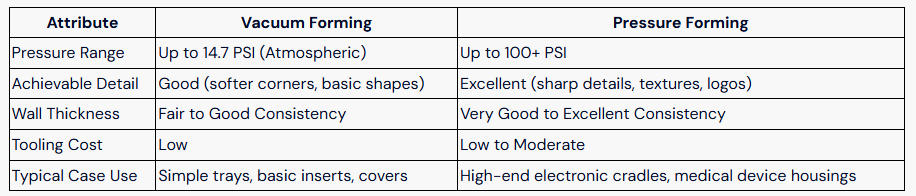
The choice between vacuum and pressure forming depends on the part’s requirements for detail, texture, and structural complexity.
What Is Vacuum Forming?
Vacuum forming relies on atmospheric pressure to pull heated plastic against a mold surface. It’s a straightforward, cost-effective method best suited for parts with smooth curves and minimal detail. Typical applications include food packaging, equipment trays, covers, and simple case inserts.
What Is Pressure Forming?
Pressure forming applies additional air pressure during molding, allowing the plastic to conform closely to intricate shapes and delicate textures. This results in sharp corners and a refined surface finish that matches the plastic injection molding quality.
Pressure forming is ideal for components where visual detail and precision matter, such as electronic enclosures, medical panels, or high-performance protective case interiors.
The comparison below highlights key differences to help identify which method delivers the best performance for your project requirements.
Thin-Gauge vs. Heavy-Gauge Thermoforming
Thermoforming processes differ significantly based on the thick gauge of the plastic sheet—which directly impacts equipment selection, production speed, and final application suitability.
Sheet Thickness and Material Handling
Thin-gauge thermoforming: Uses plastic sheets less than 1.5 mm thick, typically supplied in continuous rolls. This enables high-speed, high-volume production, which is ideal for lightweight, disposable products.
Heavy-gauge thermoforming: Utilizes thick sheets over 3 mm thick, handled individually rather than in rolls. This plastic manufacturing process produces sturdy, structural parts designed to withstand rigorous use.
Cycle Times
Thin-gauge: Cycle times are very short—often just seconds per part—supporting rapid manufacturing throughput.
Heavy-gauge: This type of work requires longer cycles, generally several minutes per part, due to the increased heating, forming, and cooling requirements for thicker materials.
Typical Applications
Thermoforming supports various applications depending on material thickness and performance requirements. The table below outlines typical uses for both thin-gauge and heavy-gauge thermoformed components.
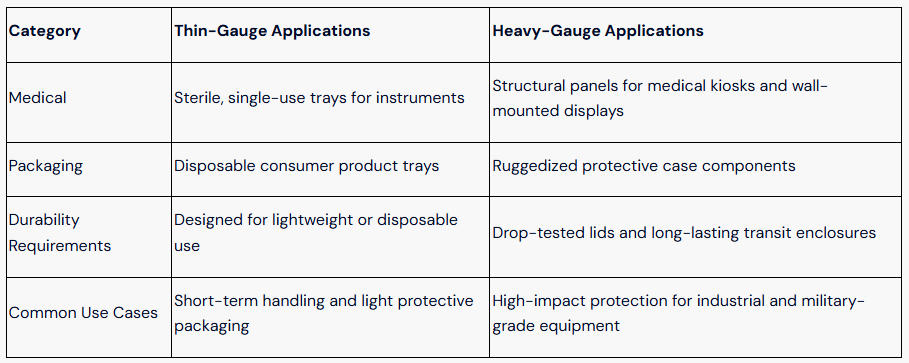
Understanding the difference between thin- and heavy-gauge thermoforming helps match the right material and design to the application’s demands. Whether you need sterile disposability or rugged impact resistance, the correct gauge delivers better performance and value.

Thermoforming Materials for Protective Cases
Material selection drives the performance of a thermoformed case insert. Choosing the right polymer is a critical decision that balances impact strength, chemical resistance, temperature stability, and cost. Other options can include a custom EVA case for different applications.
ABS (Acrylonitrile Butadiene Styrene)
Well known for excellent impact resistance and good chemical resistance; withstands moderate temperatures (good temp. range); moderate cost; easily recyclable.
Polycarbonate
Superior impact strength (toughest among common plastics); chemical resistance is fair to moderate (can be sensitive to some solvents); excellent temperature range (high heat resistance); higher cost; recyclable.
HDPE (High-Density Polyethylene)
Outstanding impact strength; excellent chemical resistance; good temperature tolerance (though not as high as polycarbonate); low material cost; highly recyclable.
HIPS (High Impact Polystyrene)
Good impact strength; fair chemical resistance (less resistant than HDPE or ABS); moderate temperature resistance; low cost; recyclable.
PETG (Polyethylene Terephthalate Glycol)
Excellent impact strength (better than regular PET), good chemical resistance, good temperature range, moderate cost, and recyclable.
Tooling & Molds: From Prototype to Production
Macro shot of a complex, precision-machined aluminum production mold emphasizing its intricate details.
The mold, or “tool,” is the heart of the thermoforming process. Its material and construction depend on the project stage and production volume. For prototypes, a 3D-printed tool can be created in under a week for quick fit checks. For pilot runs, an epoxy-tooling board is a cost-effective intermediate step.
For full-scale production, temperature-controlled aluminum molds are the standard. These durable tools can produce hundreds of thousands of parts with perfect consistency.
Expert tool design is critical for success. Engineers must account for draft angles, structural ribs, and undercuts to ensure a high-quality, repeatable thermoformed part.
Key Advantages of Thermoforming for OEMs & Case Manufacturers
For Original Equipment Manufacturers (OEMs) and those needing custom case solutions, thermoforming presents a powerful combination of benefits:
Low Tooling Investment: Tooling costs are a fraction of those for injection molding, with a typical break-even point on yearly projects.
Fast Turnaround: Production-quality parts can be delivered in weeks, not the months often required for injection mold tooling.
Design Versatility: The process allows for large parts, complex geometries, and a wide variety of molded-in textures and branding.
Scalable Volumes: Thermoforming is economically viable for pilot runs of a few hundred units up to production runs of tens of thousands.
Compliance & Traceability: The process is fully compatible with stringent quality systems like ISO 9001 and can utilize materials that meet Berry Amendment and International Traffic in Arms Regulations (ITAR) requirements.

Industries Benefiting from Thermoformed Case Solutions
The versatility of thermoforming makes it ideal for a diverse range of industries where protection and precision are non-negotiable.
Military & Defense: For shock-proof transport of sensitive electronics, weapons systems, and communication gear, with ITAR-compliant solutions for drone ground-station cases that must withstand extreme field conditions.
Medical & Healthcare: Creating sterile, durable, and easily cleanable trays for surgical kits, diagnostic equipment housings, and mobility device components, including flexible silicone cases.
Electronics & Industrial: A superior alternative to foam for creating non-abrasive, non-corrosive, and perfectly fitted inserts for precision tools, calibration kits, and sensitive electronic components.
Thermoformed solutions are ideal alternatives for precision carriers and components where the twin sheet forming techniques can be utilized in matched mold forming systems to enhance structure and rigidity.
No matter the application, these custom solutions help ensure safety, efficiency and reliability where it matters most.
Precision-Molded Protection for Critical Equipment
The thermoforming process delivers design flexibility, fast turnaround, cost efficiency, and long-lasting durability. It is an ideal method for producing custom protective case interiors tailored to critical equipment.
When failure isn’t an option, thermoformed inserts offer the precision and dependability needed to safeguard valuable assets, with peace of mind built in.
Looking for a custom case solution? Work with Trumpartner to design thermoformed cases that deliver the protection, fit, and performance your project demands.